


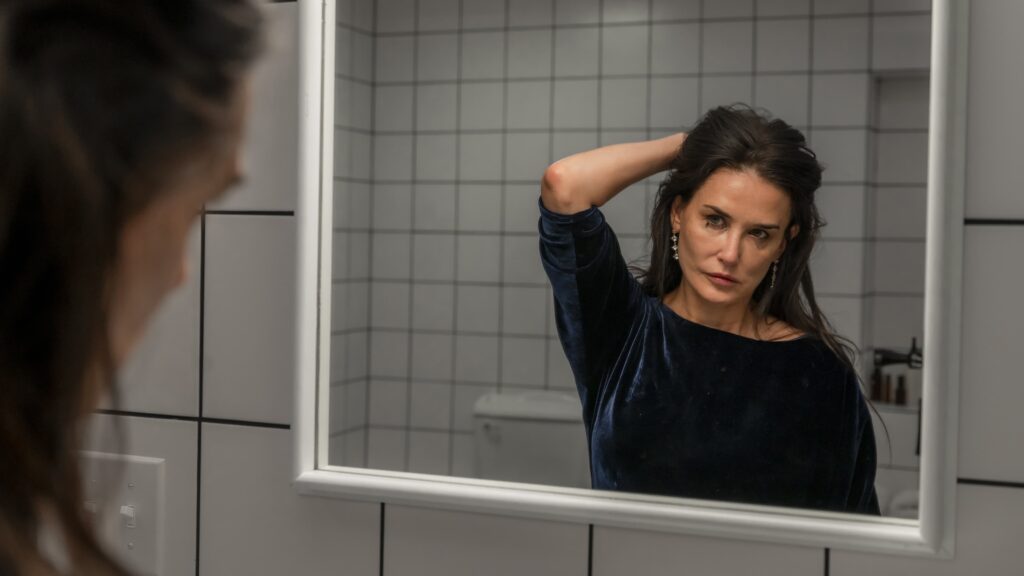
After winning Best Actress at the SAG Awards, Demi Moore has solidified herself as the frontrunner this Oscar season. With five Academy Award nominations,including Best Actress for Moore, Best Makeup and Hairstyling, Best Original Screenplay, and Best Director for Coralie Fargeat,The Substance has become one of the most talked-about films of the year. Moore’s fearless performance has been widely praised by critics and audiences alike, and after her SAG win, her chances of taking home the Oscar have never looked stronger.


In an era where social media dictates beauty standards and personal worth, Coralie Fargeat’s The Substance emerges as a fearless cinematic reckoning. A film that pulls no punches,both visually and thematically,it weaponizes the camera against its audience, forcing them to confront their own complicity in the glorification and destruction of female stars. Now, with its recent awards season recognition, The Substance cements itself as one of the year’s most provocative and unrelenting films.
The film follows a once-revered actress, a woman celebrated for her beauty, whose career and sense of self begin to disintegrate once she steps out of the limelight. Though those closest to her still see the “most beautiful girl in the world,” the world’s gaze has shifted, leaving her in desperate pursuit of relevance. This obsession leads her to an experimental solution,a horrifying transformation that pushes her beyond recognition.
With its grotesque, boundary-pushing practical effects, The Substance is a visceral horror film, but its true terror lies in its themes: the annihilation of authenticity in favor of perfection. The film critiques a culture obsessed with youth, beauty, and approval, a culture that encourages individuals to present a flawless version of themselves at the cost of their own identity. As the protagonist clings to an idealized version of herself, her real self is left to rot,until nothing remains but a monstrous distortion of both.
Fargeat’s direction is unflinching. The camera’s roaming, wide-lens shots often linger uncomfortably on bodies, exposing not just flesh but the audience’s own gaze,calling out the hypocrisy of a world that sexualizes women on its own terms but recoils when that gaze is turned against them. The Substance doesn’t just observe; it accuses. It forces viewers to question why they feel unease when agency shifts.
Despite its heavy reliance on shock value, which at times risks undermining its thematic weight, the film’s ambition is undeniable. Some of its satirical moments don’t fully land, and the film occasionally feels at war with itself,yet, perhaps, that’s the point. The protagonist battles between her real and artificial self, much like the film wrestles with its own balance of horror and commentary.
Beyond its critical acclaim, The Substance has been met with awards season recognition, solidifying Fargeat as a filmmaker with intent and a voice that demands attention. Its nominations stand as a testament to the necessity of bold, uncompromising storytelling. In a landscape often filled with safe, commercially viable choices, films like The Substance are vital,they challenge, disturb, and, most importantly, refuse to be ignored.

